
Why Do Epoxy Garage Floors Peel? (And How Coastal Slabs Make It Worse)
By Santa Monica Epoxy Flooring · Updated · 1 min read
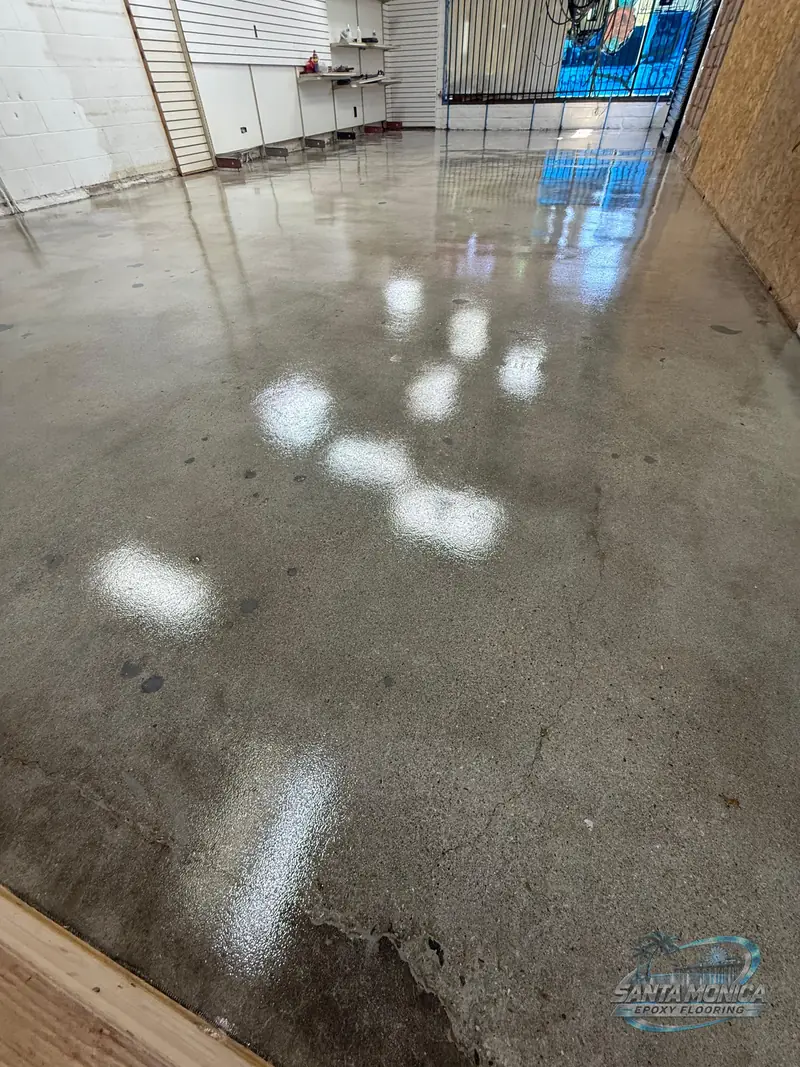 See more: Grind & seal ›
Epoxy floors peel for four reasons: poor prep (no diamond grinding), moisture coming up through the slab, thin coatings, and hot tire pickup on a soft topcoat. Near the coast, moisture is the big one, which is why we test every slab before choosing a basecoat.
1. No grinding
A coating needs a rough, open surface to grip. Acid etching or just pressure washing leaves a smooth, weak surface. Diamond grinding takes off the top layer and opens the concrete.
2. Moisture from below
Concrete is porous. Water vapor moves up through it, especially on slabs close to the water table. In Venice, Marina del Rey, Playa del Rey and the beach cities we often see white powder on garage floors, which is efflorescence left by that moisture. Coat over it without a vapor barrier and the coating can blister and lift.
3. Thin material
Hardware-store kits are often water-based and very thin. They wear through in the tire paths fast.
4. Hot tires
On a warm day, hot tires soften an epoxy-only topcoat. When the car pulls out, the tire takes the coating with it. A polyaspartic topcoat prevents that.
How we avoid it
- Diamond grind every slab
- Moisture-test before choosing the basecoat
- Use a vapor barrier first coat when readings are high (our 5-layer build)
- Finish with polyaspartic
Can a peeling floor be fixed?
Yes, but the old coating has to come off completely. That is the coating-removal line on a quote, and it is the most common reason two quotes differ.
Frequently Asked Questions
Why is my garage epoxy peeling?
Usually poor prep, slab moisture, a thin coating or hot tire pickup on an epoxy-only topcoat.
Can you put new epoxy over peeling epoxy?
No. The failing coating has to be ground off first or the new one fails with it.
How do you test a slab for moisture?
We take moisture readings on site. If they are high, we use a vapor barrier basecoat.